Showing posts with label products. Show all posts

Wednesday, February 1, 2012

Two Indispensable Shortcut Ingredients

While we all have it drilled into our collective culinary psyche that fresh is best when it comes to food, we know that going to great pains to obtain and make absolutely everything fresh and/or from scratch is a feat best left to professional chefs in professional kitchens with professional teams of underlings to do all the grunt work like grating fresh coconut flesh to make fresh coconut milk, or trimming and cooking artichokes to get to the heart just to grind it up for a sauce or dip.  While many home "chefs" try to make as much as possible from scratch and buy the freshest they can get, it can be pretty difficult and time consuming.  I know the last thing I want to do after a long day of work is making fresh coconut milk and pounding away at fresh, made-from-scratch Thai red curry paste.  I want Thai red curry, and I want it in less than an hour...and I don't want to have 3 hours of cleanup time afterwards.

I have made Thai curry paste from scratch before, and it's a fun weekend project that yields flavors that you'll never find in a can of pre-made curry paste.  The coconut milk I have yet to attempt...and I don't see myself attempting that task anytime soon.  When I want a quick Thai coconut milk curry, though, I just reach for a can of curry paste (or the tub I keep in the fridge), add some reconstituted coconut milk and voilà!  With the addition of some sliced chicken and vegetables, I have Thai curry!

Those who know me, know that there are certain things that I like to make from scratch regularly and I prefer to do that than to buy them ready-made at the store.  Yogurt is one of them.  If you get a yogurt maker, it's the easiest thing in the world and will cost you a fraction of what you pay for inferior stuff at the grocery.  Another thing I always do myself are spice blends.  When making South Asian curries, I almost always insist on roasting and grinding my own spices.  There are quite a few things, however, that I take shortcuts on.  For Biryanis, and many Pakistani dishes, I will use pre-packaged seasonings made by Shan.  Unless you worked at Moti Mahal in New Delhi for ten years, you will never get a biryani that tastes as good as one made with Shan masala packets.  I also use jarred ají amarillo and ají panca pastes instead of reconstituting and blending whole chiles for making Peruvian dishes.  I love to use frozen peas to add to dishes, as well as frozen broccoli florets.  Additionally, I keep a pouch of coconut milk powder for making sauces and curries (Thai brands like Chaokoh are packed with fresh coconut flavor and are infinitely better than any canned variety).  Furthermore, although I have a pasta machine and love to make fresh pasta, there are still boxes of dried pasta in our pantry.

There are a few shortcut ingredients that I think are indispensable to the home cook, and they may not be that well-known to many people.  They have saved me a lot of time, and have enabled me to make more elaborate dishes in less time...as well as saving on cleanup time, which is always great.

  1. Ginger Paste
    • There is nothing like the taste of fresh ginger, although peeling and grating a chunk of ginger root to find that you have to throw half of it out because it was more than what you needed (contrary to what people say, ginger root - once peeled - does not keep well) can be a pain sometimes.  Ginger paste is an essential ingredient for many, if not most, South Asian cooks.  The jars can be found at most Indian groceries and can keep in the refrigerator for months.  Nothing beats the ease of opening a jar and taking out a few spoonfuls to flavor a Korean barbecue marinade or to add into a curry or salad dressing.
  2. Garlic Paste
    • Better than the convenience of ginger paste, in my opinion, is the convenience of garlic paste.  I have used Indian garlic paste in the paste, but I found that the flavor lacked the pungency of fresh garlic - it had more of the sweetness of roasted garlic, and there flavors of the preservatives were really noticeable.  Why Indian garlic paste is acceptable for making South Asian curries, I've found that Peruvian garlic paste is actually more versatile.  I'd get a jar of this paste, which can be found in most well-stocked supermarkets, and use it for both Indian and other types of cuisines.  There is a bit of salt added as a preservative, but Peruvian garlic paste is the closest you'll get to pressing your own fresh garlic.  The best part is that there are no stinky fingers involved - just scoop out as much of it as you want and put it back in the fridge.  Like the ginger paste, the garlic paste can last in the refrigerator for months.
I've found myself using both of these shortcut ingredients so much that I rarely buy fresh ginger or garlic anymore.  I will admit that they do not replace the flavors and textures of fresh ginger and garlic, but for a quick alternative, they are the next best thing and are perfect for marinades, sauces, stir-fries, and curries.

Monday, January 30, 2012

Provoleta

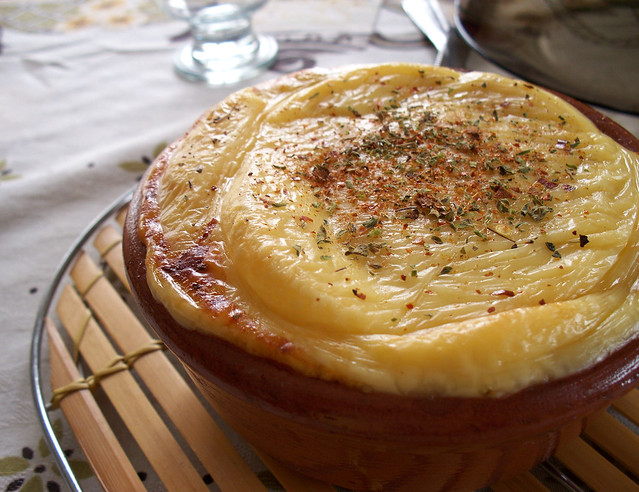
Last night we just fried up the provoleta that I had trekked down to Graziano's in Miami to purchase for Christmas Eve dinner.  Considering that the Noche Buena table was already heavily weighted with all sorts of cured meats, cheeses, breads, panetón, marinated vegetables, fresh anchovies, and John's Swedish meatballs and a spiral ham, as well as a platter of pigs in blankets, we decided to hold off on the provoleta that night.  However, every time I opened the "deli drawer" in the refrigerator, the vacuum-sealed package of two pale disks sprinkled with dried oregano and chili flakes kept looking back at me, almost asking me if tonight was the night it would get eaten.  Well, John decided to purchase some crusty Italian bread and make last night the night that we would partake in this Argentine and Uruguayan delicacy.

Argentina and Uruguay really don't have a very complex or even interesting cuisine.  It's actually very simple and relies heavily on grilled steaks and New World interpretations of European - mostly Italian - dishes.  Go to any Argentine and/or Uruguayan grocery or restaurant and you will be confronted by mostly a selection of meats and sausages, as well as a selection of pastas - no exotic seasonings, and very few vegetables.  Don't get me wrong.  The few dishes that comprise both countries' cuisines are very well made, and both Argentina and Uruguay are known throughout the world as being masters in grilling steaks.  Additionally, I consider the best Italian inexpensive Italian food to be had in Miami is to be had at an Argentine or Uruguayan restaurant; just like the Italians from which many of them descend, they have unrelenting standards when it comes to quality of ingredients and freshness.

Perhaps the national dish of both countries is La Parrillada (or El Asado), which is closest in nature to an American barbecue, but is comprised of different cuts of grilled beef, as well as sausages and some offal (their grilled sweetbreads are some of the best that I've tried).  As an appetizer to this style of cooking, there is provoleta, which is a slice of firm provolone (not the kind used in an Italian sub sandwich) coated with oregano and chili flakes and quickly grilled over a very hot open flame rendering a crispy crust and a gooey interior.  Call it South American fondue (or raclette), if you will.  

The technique is pretty tricky to master, as the cheese can drip through the grates of the grill and cause flare ups.  The short cut way to make provoleta is on the stove.  Leave the provoleta out for about an hour, unwrapped, so that the exterior forms a sort of light "crust".  You might have noticed this with cheese plates that have sat along too long, especially on cheeses like gouda or cheddar.  When ready to prepare, heat a nonstick pan over medium heat and add just a little bit of oil to coat the bottom.  Place the slice of provoleta on the frying pan, and cook until bubbly and crusty on one side, then flip over with a spatula until a slight crust forms on the other side.  Put the provoleta on a plate and eat immediately with a baguette or ciabatta.  This really is a great dish to serve with wine for a an informal get-together.

Sunday, January 22, 2012

My New Thing: Mustard Oil

One of the cuisines I've been obsessed with for over 12 years has been South Asian cuisine.  Over the years I went from adding every ground spice imaginable to a pot of simmering yogurt to realizing the differences between regional South Asian cuisines and refining my own spice mixtures and sauces to the point that I consider myself pretty pretty familiar with Indian cooking and cuisine.  Most of the dishes I try to make are from Northern India (Delhi and Punjab), as well as some Pakistani dishes.  I have also delved into southern Indian cuisines from Tamil Nadu and Kerala.  One regional cuisine that I have yet to experiment with is Bengali cuisine.  I'm familiar with their spice blend called panch phoron that contains 5 spices usually consisting of cumin, fenugreek, fennel, black mustard, and nigella.  The cuisine of Bengal and surrounding regions uses a lot of fish, thickens foods with ground poppy seeds, is particularly famous for its sweets (gulab jamuns and rasgullas) and is very fond of mustard - good, strong mustard.  Bengali cuisine is also known for its use of mustard oil as a cooking fat, which is unique to the region.

I went yesterday to my favorite Desi (South Asian) grocery, Asia Grocery, to stock up on some supplies and decided that I should buy a small bottle of mustard oil and start experimenting with Bengali cuisine.  As I was putting away packages of spices, dals, food dyes, and syrups, I decided to open up the small bottle of mustard oil and give it a taste to see what I'd be working with.  Once the drop of oil hit my tongue, it was like a new culinary portal was opened to almost endless possibilities.  This is going to be one of my new ingredient obsessions!

Imagine an oil that tastes like dijon mustard or chinese mustard!  Imagine being able to infuse that flavor as a backdrop to complex curries, or adding a few drops into salad dressings.  For dinner this evening, I used up the last bits of cucumber and daikon radish for a quick relish.  I made paper thin slices of both vegetables and marinated them in a mixture of white vinegar, salt, cayenne powder, black pepper, and just a few drops of mustard oil.  It was a flavor explosion that went beautifully with the tartness of the vinegar and the spice from the cayenne powder.  I can only imagine what a dash of sugar would do to such a dressing!

Think of mustard oil the same way you would think of sesame oil - a few drops can really add a je ne sais quoi to whatever dish you're making and really pull everything together.  Look for it the next time you're shopping for South Asian ingredients

Thursday, January 12, 2012

How do you get the taste of curry out of your mouth?

The answer is mukhwaas!

Every South Asian meal should end with paan, but if paan is unavailable, there should be mukhwaas.  This comes after dessert, after chai or coffee, when you've decided that dinner and drinks are officially over.

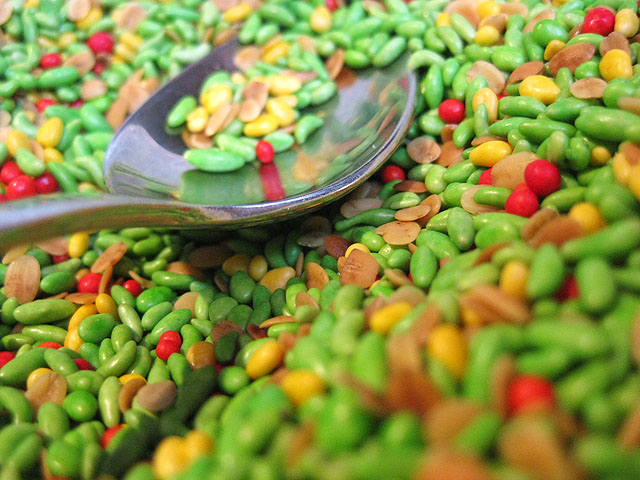
I rediscovered my canister of mukhwaas while rummaging through my cupboard looking for some spice I thought I had, and quickly took a break, sat down in front of the television, sprinkled some into the palm of my hand and had a blissful mouth-freshening moment.  Mukhwaas is a mouth freshener, and after paan (which is almost impossible to find freshly-made in South Florida, but practically omnipresent in NYC or Chicago), it is the most perfect end to an Indian/Pakistani/Sri Lankan/Nepalese/Bangladeshi meal.  There are countless varieties of mukhwaas with all sorts of secret breath-cleansing ingredients, but most mixtures that I've found contain, first and foremost, saunf - fennel seeds.  These can be plain fennel seeds, but are more commonly sugar or candy-coated fennel seeds, which have a slightly medicinal, licorice-like flavor, but with more of a "green" note to to them than licorice or anise seeds.  To the fennel seeds are added a myriad of other ingredients, which can include:  minuscule sugar candies, sprinkles, melon seeds, chopped dates, dried herbs, silver leaf, coconut, betel nut shavings, rose petals, and even little bits of sandalwood or sandalwood essence.  There is nothing that cleanses the palate better after a multi-course Desi (South Asian) feast than mukhwaas.

At any good Desi restaurant frequented by South Asians, you will find a bowl of mukhwaas at the entrance (or sometimes even a jewelry box-looking thing by the hostess stand) with a teaspoon.  Like probably most goras (non-Desis), I had passed by such bowls for years thinking that it was some type of potpourri.  It was only after seeing someone at an Indian restaurant sprinkle a spoonful of the stuff into his right hand and pop it into his mouth that I followed suit and had my post-Indian meal epiphany:  this is the ultimate breath-freshener, and pretty natural compared to all the breath mints and gums out there!

Mukhwaas can be purchased at almost any South Asian grocery either in large pouches for placing into your own bowl at home or in canisters.  My canister has about half a dozen different compartments, each with a different mukhwaas mixture - some consisting of nothing more than sugar-coated saunf, and others consisting of exotic and luxurious combinations of seeds, spices, and dried fruits.  There are also countless brands of single-serving mukhwaas sachets that make excellent additions to lunch boxes as a unique post-lunch refreshment.  So, next time you're at a South Asian restaurant, make sure not to skip the big bowl of mukhwaas.  You're mouth will rejoice...and your dinner date will thank you for it later, I'm sure!

The best place to get a huge selection of mukhwaas, as well as pre-packaged paan and any South Asian foodstuff you could ever want is:

785 Miller Drive
Miami, FL 33155
786-268-7700

Sunshine Indopak Grocery in North Miami Beach is probably the next most recommended South Asian grocery.

If you are simply physically incapable of driving down to Miami, Little Market is a less-than-satisfactory alternative in Broward County, although don't expect any help from the shopkeeper, and bring cotton to stuff into your nose as this place always seems to reek of sulfuric-smelling hing (asafetida)

Tuesday, January 3, 2012

Lúcuma Ice Cream Mix

Neopolitan ice cream usually is composed of three distinct flavors: chocolate, vanilla, and strawberry.  This is true in almost every country but Peru, where Neopolitan ice cream consists of chocolate, vanilla and lúcuma.  Lúcuma is a fruit that is native to Peru and has been prized since pre-Inca times as can be seen pottery motifs from that period.  It is related to the canistel fruit that grows in South Florida and is widely cultivated in Cuba and the Caribbean.  The flavor is hard to pinpoint and is something that brings warm and fuzzy feelings to most Peruvians just like peanut butter with Americans.  It is one fruit that, while sweet, has a great deal of umami that made me compare it in flavor to a very astringent tomato.  Of course, the idea a tomato-flavored ice cream is one that would be challenging even to the most adventurous eaters.  Upon tasting a ripe persimmon for the first time, I realized that the flavor was similar and both it and the lúcuma have an astringent quality to them.  Still, it wasn't quite the same.  The best description I've seen was first read in a Travel + Leisure article on the new Lima and its vibrant food scene, which described the taste of lúcuma as a cross between maple syrup and sweet potato.  Although much more complex than that, this seems to be the most spot-on description for American palates.

Fresh lúcuma, outside of Peru and California, is almost impossible to come by.  Frozen lúcuma pulp is available at most Peruvian groceries in South Florida, but costs anywhere from $7 to $15 for a packet.  Lúcuma ice cream produced by D'Onofrio is now readily available in most well-stocked Peruvian groceries, but are still about 3 times the price of their American Blue Bunny counterparts.  During my last trip to a Peruvian grocery called Mi Tierra in North Miami Beach, I found a sachet of instant lúcuma ice cream mix for a reasonable price made by Universal brand, which also makes other instant ice cream mixes like guanábana (soursop) and maracuyá (passion fruit). The instructions on the back of the packet required the use of an electric hand mixer to beat the powder together with one cup of milk until it becomes foamy and doubles in volume.  In effect, it creates a lúcuma mousse.   Given the lack of readily-available ice cream makers to the Peruvian middle and working class, the instructions then require you to fill serving cups with the mousse and leave in the freezer until it sets.  I decided to make a richer base with a combination of heavy cream and whole milk and froze it in a Cuisinart ice cream maker.  The resulting ice cream was rich and dense and tasted just like D'Onofrio lúcuma ice cream.  I recommend buying it if you're a fan of lúcuma ice cream or as a sweet finale to a Peruvian dinner.

Mi Tierra
16461 W Dixie Hwy 
North Miami Beach, FL 33160
(305) 947-1935

Monday, January 2, 2012

Rice Report: Rico Rice

I'm always on the lookout for a good long-grain rice for day-to-day cooking.  With Basmati and Jasmine rice being so expensive these days, I tend to only use those rices for South Asian and East Asian food, respectively.  When I'm making other foods - especially Latin American dishes - I need something a little simpler.  Although I'm a spendthrift through and through, I've found that with rice you really get what you pay for.  Never go for the bargain stuff as it tends to clump up and the grains break up into unrecognizable little bits.  Thrifty Maid is one of the absolute worst that I've used and has given me countless pots of rice that I've had to throw away...rice that I'd be ashamed to serve anyone.  My go-to rice has always been Canilla, which is produced and marketed by Goya.  With a good rinsing and careful preparation, it's almost always produced a good pot of fluffy rice where the grains are all separated and have a slight chewiness, a quality known as desgranado in Spanish.  

Recently at the store, Rico rice was on sale for about half the price of Canilla.  I've heard of Puerto Ricans using Rico rice almost exclusively and decided to buy a 5 lb bag.  The individual grains were, for lack of a better word, beautiful!  Each one held its shape and there were very few broken pieces.  In fact, the packaging advertises that there are fewer than 4% broken pieces in each bag.  Rinsing can usually cause grains to crumble and fall apart, and I was pleased that the Rico grains retained their shape.  After boiling with some olive oil, salt, and the correct proportions of water (1.25 parts water to each part rice), I uncovered a pot of the most perfect white rice I have ever made!  For anyone who cooks rice on a daily or weekly basis, I highly recommend Rico.  I know it will be in my pantry from now on.

Injera on my mind...

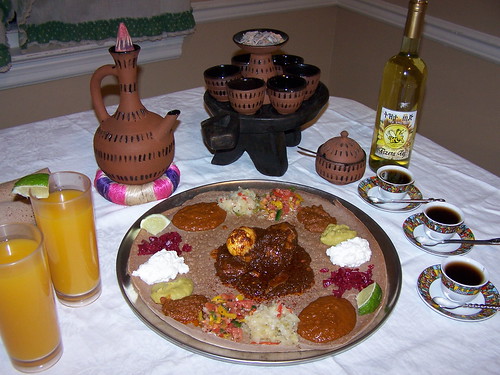
With the closing of Miami's first Ethiopian restaurant, Sheba, more than two years ago now, as well as the subsequent closing of Kaffa, located just down the street, one now has to fly up to DC just to have some Doro Wat, Kitfo, T'ej, and freshly roasted Ethiopian coffee.  What a surprise that Miami just wasn't ready for Ethiopian cuisine [insert sarcastic tone here].  The chief complaint I've heard - and quite the ethnocentric one - was "where's the rice?"  It seems as if Miami's Latin American community has it so ingrained in their psyche that any type of stew NEEDS to be served with rice that if it's not, there's just something wrong with it.  Ethiopia's staple is not rice, but a spongy sourdough pancake called injera.  Add to the lack of rice the fact that injera is grey-colored, spongy, stretchy, and has an unmistakable tanginess to it and there's no surprise as to why Miami's two Ethiopian restaurants shut down within months of each other.  There is no escaping injera in Ethiopian cuisine, just like there's no escaping rice in Asian and Latin American cuisine, especially considering that besides being the starch of your meal, it is also your eating utensil and your plate.  If you don't like injera, then chances are that you won't enjoy Ethiopian cuisine, and to enjoy Ethiopian cuisine you just have to buckle down and develop a taste for injera...that is, unless, you had already fallen in love with it on first bite.

The very qualities that deter most people from injera are the same that attract people to it and to Ethiopian cuisine, in general.  Ethiopian dishes, besides being laden with spices and chiles, also use a great deal of spiced clarified butter, called nitter kibbeh, which gives many Ethiopian dishes an exquisite richness.  The sourness of the injera cuts that richness, and its sponginess helps to soak up the juices.

I had been wanting to experiment with making Ethiopian cuisine at home, but without injera, there is just no way I can do justice to the cuisine.  Unlike rice, couscous, or even naan, injera is something that is hard to find ingredients for, hard to find equipment for making it, and a little complicated to make.  Injera is made from teff flour, which comes from one of the smallest grains in the world and is native to Ethiopia.  Without teff, you cannot make injera, and thus cannot make an Ethiopian meal.  Luckily, I was able to find teff flour made by Bob's Red Mill, which produces phenomenal grains and cereals, at a Publix Greenwise Market.  That was the clue from fate that 2012 will be the year in which I experiment with Ethiopian cuisine and injera.

Like sourdough, the batter for making injera needs to be fermented, and you always need to start with an injera "starter" just like when you make yogurt.  I spent a greater portion of last night doing a bit of research.  I found one recipe from an Anglo woman's blog who has a great love for Ethiopian culture.  She goes through step-by-step processes of how to make an injera starter, and how to make VERY authentic injera.  She's even gone through the trouble of getting an electric mitad (injera griddle) and other traditional implements.  You can check out her instructions and instructional videos here.  The other recipe seems a lot less complicated and actually comes from an Ethiopian webiste, called www.ethiopianrestaurant.com.  I'm thinking a fusion of both recipes would be ideal.  I'm not quite ready to make injera yet, but will definitely keep you posted of when I do venture into my first batch of of it....hopefully with some good Doro Wat and even better company.

Sunday, January 1, 2012

Gilt Taste Offers Peruvian Products

So I guess Peruvian cuisine is getting a little more recognition within the US gourmet scene as evidenced in Gilt Taste's offerings of organic Peruvian products that include things that are exotic even to most Peruvians (Pussac Punay and Kañiwa?).  I was glad to see a collection of ají pastes that include ají amarillo (the backbone of Peruvian cuisine), ají limo (for ceviches), and ají panca (Peru's answer to chipotle).  Ají is what us Peruvians call chili peppers (chiles for Mexicans).  There is also a selection of dried ají powders, which I've never had experience with, but considering that 99.9% of Peruvian cuisine - regardless of the region - uses fresh ají, I wouldn't recommend the powders.

There are also a lot of flours and grains offered, like quinoa, kiwicha (amaranth), purple corn flour, and others.  While some of these products are not representative of products Peruvians actually use, it is interesting to see that such native products are being cultivated and packaged and will probably go to use in the nouveau Peruvian cuisine that is coming into its own these days but has yet to conquer the world like other ethnic cuisines have.  It might just be an issue of marketing, although I think that the issue is much deeper than that and has a lot to do with how non-Latin Americans view Latin American cuisine drawn from their experiences with Mexican and Caribbean cuisines, which have nothing to do with Peruvian cuisine.  You'll probably read more of my thoughts on contemporary Peruvian cuisine in the future, but for the mean time, check out the Peruvian products on sale at Gilt Taste, as well as their well-chosen selection of other gourmet products (I'm ogling the molecular gastronomy pantry items....maybe it's the year to experiment with xanthan gum and soy lecithin)